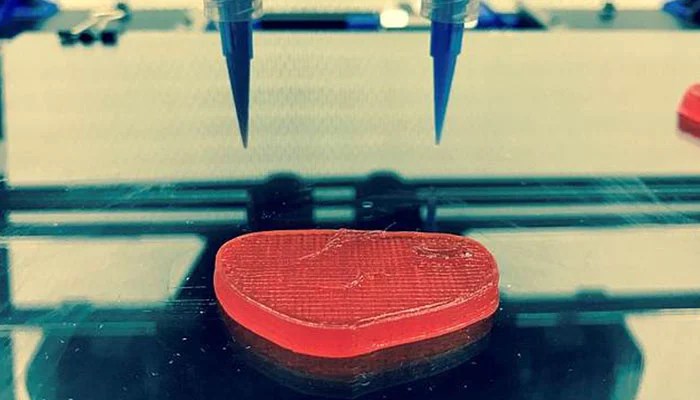
3D printing is an emerging technology capable of producing plant-based “meat”.
A recently published article (August 2025) in sciencedirect reviews the 3D analog printing of plant-based “meat”.
This review summarizes and critically analyzes the scientific studies related to the 3D printing of plant-based “meat”.
Plant proteins, oils and water are the main ingredients for the composition of the ¨ink¨ that will do the printing to create 3-d “meat”.
Hydrocolloid, enzyme, yeast, pigment, flavor, etc. are used as secondary ingredients.
All these components, depending on their composition, modify the rheological properties of the “ink” and, consequently, the 3D printing performance and stability after printing the “meat” analogs.
Printing temperature, contact angle, nozzle height, nozzle diameter, layer height and nozzle movement speed are the most critical parameters that affect the printing of “meat” analogs.
Air heating, baking, steaming, frying and microwave heating have been successfully used for the final cooking of 3D printed “meats”.
All this process affects the functions and stability of printed “meats” intended for human consumption.
Vegetable proteins and oils
The vegetable proteins used are mainly wheat, soy, pea, mung bean, the oil is soy, corn, canola, sunflower, sesame, coconut, cocoa, avocado.
Various ingredients
Hydrocolloids, enzymes, yeast, pigments, minerals and trace elements, flavors, preservatives are often used as secondary ingredients in the composition of the ¨ink¨ to give texture, consistency, strength, stability, friability regulation.
In the research stage
The red color of the “meat” can be achieved by adding beetroot pigment, the addition of prebiotics and probiotics that are beneficial for health is still in the research stage.
The lack of pleasant taste and the lack of the presence of unpleasant taste in the final product has not yet been achieved.
The long shelf life of the product can be achieved with appropriate heat treatment, pH control, and the addition of preservatives, and this is still in the research stage.
THE NUTRITIONAL PROFILE, i.e. what nutritional value these compounds of the ingredients we mentioned will give us as a result, of the produced ¨3-d plant-based meat product¨ IS NOT MENTIONED IN THE BIBLIOGRAPHY, as well as the possible degradation of the functional and nutritional characteristics of the 3D printed product over time.
There is also no research on how the composition and characteristics of these 3D printed ¨meats¨ can help specific groups of consumers, namely people with food-related diseases (celiac disease, diabetes, hypertension, obesity, dysphagia), as well as people with personal eating habits (vegetarianism, veganism).
In summary, is it better to promote research for better living and feeding animals with more natural products, so that they yield better quality meat, contributing to a better and healthier final natural product?
To carry out large campaigns with seriousness and duration to improve people’s eating habits, campaigns for healthier nutritional adequacy in the market, campaigns promoting activity and exercise at all ages?
To synthesize various materials to give us a dubious final product simply to satisfy large companies that will conduct research with dubious results, as it takes many decades for such safe (?) products to come to the market, is truly utopia.
The health and well-being of people should be the main concern of state governments, but is that so?
 Diet gun
Leave a comment