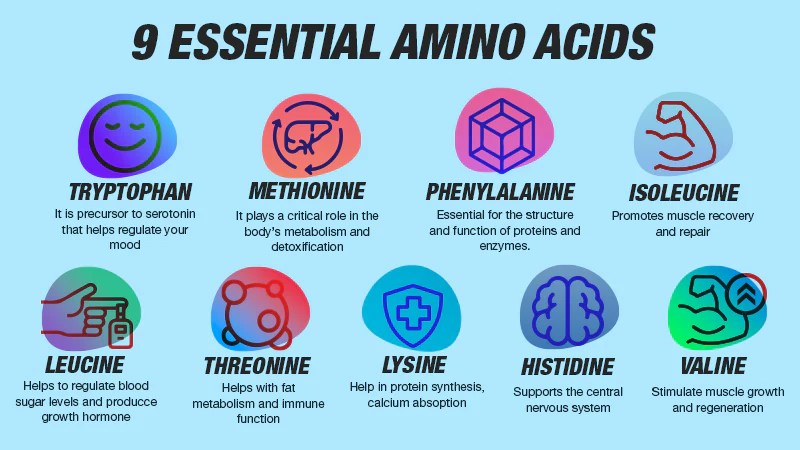
Amino acids, the building blocks of proteins, are essential for many functions of the body, such as tissue growth and repair, nutrient transport and muscle performance enhancement.
Amino acids are divided into essential (which the body must obtain from food) and non-essential (which it can synthesize on its own).
The essential amino acids are: leucine, isoleucine, valine, lysine, methionine, phenylalanine, histidine, threonine and tryptophan.
Of these amino acids, leucine, isoleucine and valine are BCAA amino acids, the so-called branched-chain amino acids that are mainly responsible for muscle growth and muscle recovery.
The non-essential amino acids are: alanine, arginine, asparagine, aspartic acid, cysteine, glutamic acid, glutamine, glycine, proline, serine and tyrosine.
Function of amino acids in cancer cells
Cancer cells preferentially use aerobic glycolysis and the metabolism of amino acids (mainly non-essential ones) is incorporated into glycolysis, favoring the growth of tumors. Basically, cancer tumors function as nitrogen traps, trapping amino acids, depriving them from the cells of the rest of the organism to maintain their activity.
There is also a regulatory mechanism in the growth of cancer tumors that is closely related to the amino acids leucine and glutamine. If there is a deficiency of these in the body, then cancer cells use amino acids from the breakdown of body tissues (mainly skeletal muscle and skin) resulting in sarcopenia, cachexia and low white blood cells.
Essential amino acids and cancer cells
Mixtures of essential amino acids, which have been used in researches, have very positive effects on cancer cells negatively affecting their survival.
Specifically, they can kill cancer cells, enhance chemotherapy with the drug doxorubicin, create autophagy in cancer cells without affecting normal cells and maintain the patient’s muscle mass.
Foods containing essential amino acids
Cancer cells depend to a large extent on non-essential amino acids.
Under normal conditions, approximately 70% of the essential amino acids released through muscle protein breakdown are reincorporated into newly synthesized muscle proteins. In patients with neoplastic diseases, this recycling efficiency is significantly reduced.
In contrast, in these patients, amino acids are released into the circulation and then deaminated to provide energy and sustain other metabolic processes.
As a result, supplementation with BCAA amino acids alone, despite their increased requirements, is not sufficient to maintain muscle protein synthesis. This is mainly because the limited availability of other essential amino acids quickly becomes the rate-limiting factor for muscle protein synthesis. Therefore, an anabolic state (maintenance and growth of muscle mass) cannot occur without the availability of all essential amino acids in sufficient quantities and appropriate ratios.
Essential amino acids are found in the following foods: meat (red meat and poultry), fish, seafood, eggs, dairy products, soy, quinoa, buckwheat and should be present in the diet to help strengthen the body.
In conclusion, the continuous administration to cancer patients of a complete mixture of essential amino acids, formulated in a stoichiometric ratio aligned with human cellular requirements, can create autophagy in cancer cells without affecting normal cells, can enhance protein synthesis and stop sarcopenia and cachexia as well as enhance chemotherapy with the drug doxorubicin.
The composition of the mixture must have medical supervision and care.
The patient should consume foods that contain the essential amino acids and to do this, the amounts of protein foods (containing the essential amino acids) should be such that the proteins range between 1.0 and 2.0 g/kg/day, with 1.2–1.5 g/kg/day for intermediate needs and up to 2.0 g/kg/day in more severe cases.
(For example, a 75 kg man should consume 1.5 g/kg/day of protein, that is, 112.5 g of protein per day. Suppose he consumes it all from chicken, then he should consume 417 grams of chicken per day (chicken contains about 27 grams of protein per 100 grams).
Source of the article
 Diet gun
Leave a comment